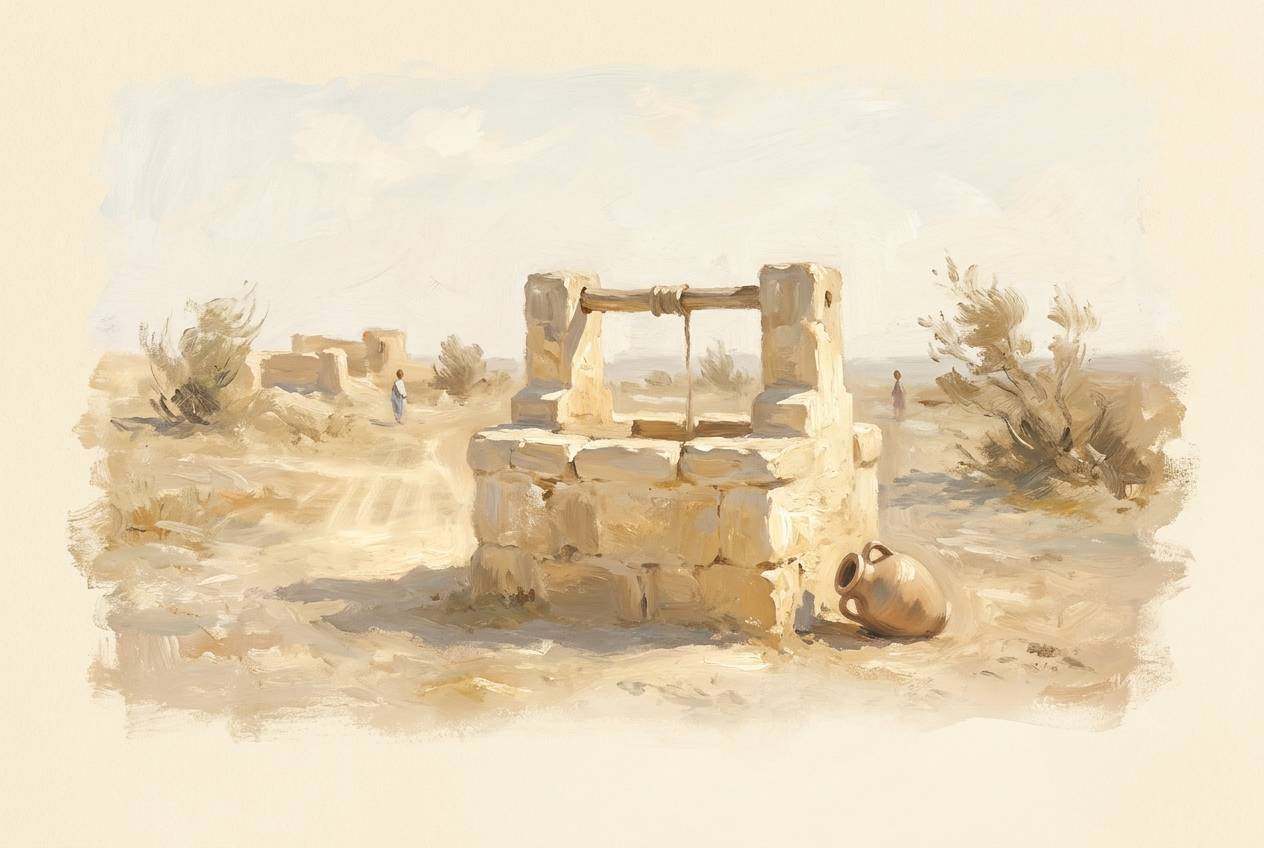
The Woman at the Well
Avoided everyone; became the first to tell.
The story
She came to the well alone. At noon — the hottest part of the day — when no one else would be there. The other women of Sychar drew water in the cool of the morning, together. She came at midday, alone. The text doesn’t say why. It doesn’t have to. Five marriages and a current relationship outside of marriage in a small town meant she knew exactly how the other women looked at her. It was easier to be invisible than to endure it.
She was also a Samaritan — a people group that Jews considered half-breed heretics, descendants of intermarriage and compromised worship. Jewish travelers would go miles out of their way to avoid passing through Samaria. She carried the weight of an entire ethnicity’s worth of dismissal on top of her own personal history.
When she arrived at the well, a Jewish man was sitting there. She probably braced herself. Instead Jesus asked her for a drink of water. She was so surprised she said it out loud — “you are a Jew and I am a Samaritan woman, how can you ask me for a drink?”
What followed was one of the longest, most theologically substantive one-on-one conversations Jesus had with anyone in the Gospels. He talked to her about living water, about worship, about the nature of God. He told her things He hadn’t openly told most of His own disciples. And when she mentioned the Messiah, Jesus said to her — this woman, alone at a well at noon, the last person anyone would have chosen — “I who speak to you am he.”
She left her water jar and ran back to town. The woman who had been avoiding people became the person who couldn’t stop talking. “Come see a man who told me everything I ever did.” And the town came. John tells us many Samaritans believed because of her testimony — the woman no one would have expected anyone to believe.
The person everyone had written off became the first person in John’s Gospel to bring a whole town to Jesus.
For you, reading this now
You’ve gotten used to being overlooked. Maybe you’ve even started arranging your life around it — avoiding the places and people that remind you how small you feel. The woman at the well had done exactly that. She came to draw water alone at noon, in the heat, just to avoid the crowd that made her feel like nothing. And a Jewish rabbi — someone who by every cultural rule of the day had no business speaking to her — sat down and had the most significant conversation of her life with her. He knew everything about her. He told her things He hadn’t told almost anyone else. And then He sent her — the woman no one wanted to draw water with — back to her town — the first person in John’s Gospel to bring a whole town to Him. You are not too small, too broken, or too far outside the circle to matter to Him. He goes out of His way for the people everyone else walks past.
This character speaks to people who feel…
Read it for yourself
The conversation: John 4:1-42 — one of the longest one-on-one conversations Jesus has in the Gospels.
Where to start: Read verses 1-26 first — the conversation between Jesus and the woman. Then verses 27-42, where she brings her whole town to Him.