Naomi
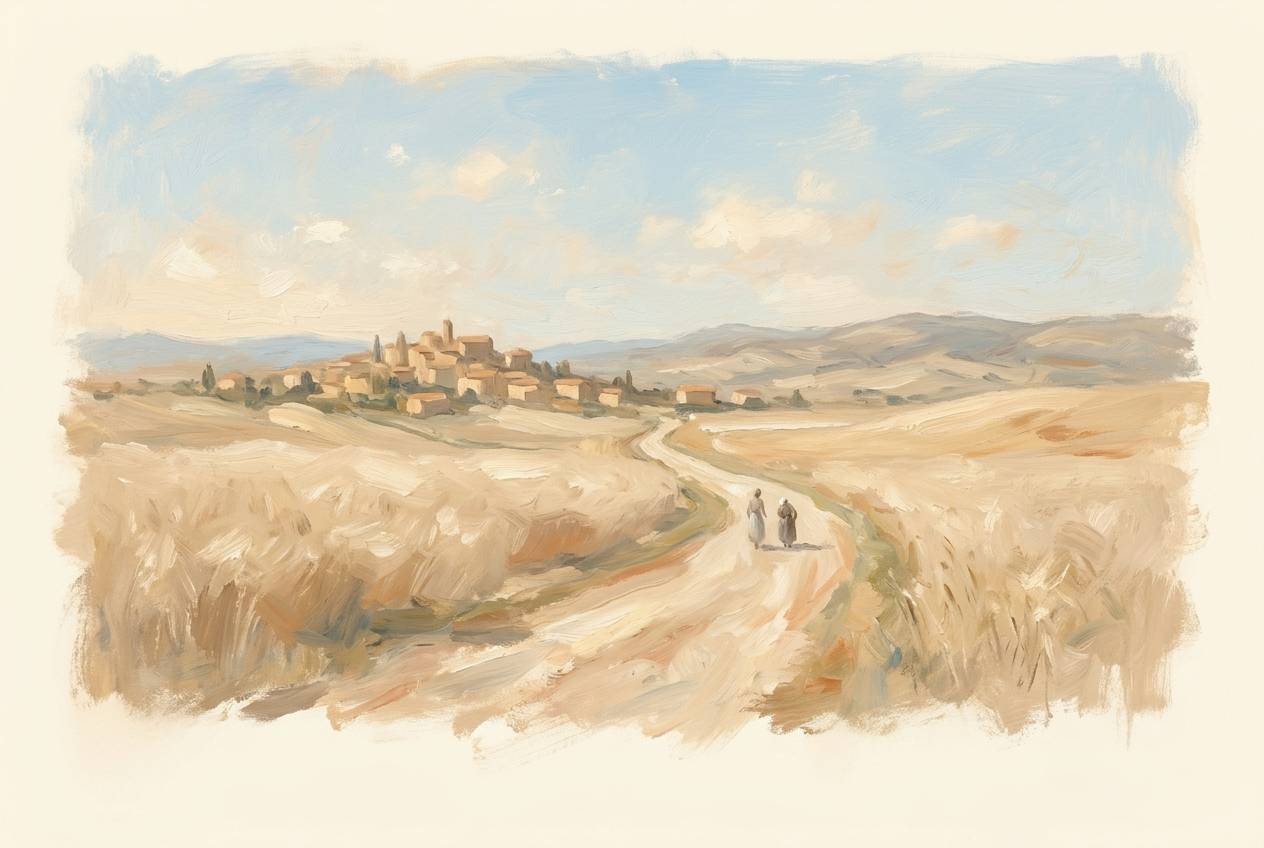
She came back empty. She didn’t know what was already walking beside her.
The story
Naomi left Bethlehem with a husband and two sons. She came back with nothing. In between — famine, displacement, the deaths of her husband and both of her sons in a foreign land. She was an older woman, widowed, childless, in a culture where a woman’s security was entirely dependent on the men in her family. By every measure of her world, her story was over.
When she arrived back in Bethlehem the women of the town gathered and called her name — Naomi, which means pleasant. And she stopped them. “Don’t call me Naomi. Call me Mara” — which means bitter. “The Almighty has made my life very bitter. I went away full but the Lord has brought me back empty.” She didn’t dress it up. She didn’t perform resilience. She named her grief out loud and gave it a new name and wore it openly.
But she wasn’t alone. Her daughter-in-law Ruth — a Moabite woman with no obligation to stay — had refused to leave her side. When Naomi had told both her daughters-in-law to go back to their own families, Ruth had said: “where you go I will go. Your people will be my people and your God my God. Where you die I will die.” One of the most famous declarations of loyalty in all of Scripture, spoken by a young foreign woman to her grieving mother-in-law in the middle of nowhere.
From that loyalty, everything turned. Ruth gleaned in the fields of a man named Boaz, a kinsman redeemer who showed them extraordinary kindness. He married Ruth. They had a son. And Naomi — who had come back empty, who had renamed herself Bitter — held that child in her arms while the women of Bethlehem said: “Naomi has a son.”
That child was Obed. Obed was the father of Jesse. Jesse was the father of David. The lineage that ran through Naomi’s grief led all the way to the throne of Israel — and beyond it, to Jesus.
She came back empty. She didn’t know what was already walking beside her.
For you, reading this now
Grief has a way of making the future disappear. When you’ve lost something or someone that defined your world, it can feel like the story is simply over — that whatever comes next is just aftermath. Naomi lost her husband and both her sons and came back to her hometown with nothing. She was so honest about it that she refused to answer to her own name. “Call me Bitter,” she said. “I went away full and came back empty.” God didn’t correct her for that. He didn’t rebuke her honesty. And He didn’t leave her alone in it — even when she couldn’t see what was already beside her. The young woman walking next to her on that road would become the beginning of a story Naomi couldn’t have imagined from where she was standing. She came back empty. She didn’t know she was already walking toward fullness. Whatever you’ve lost — the emptiness you feel right now is not the final shape of your story.
This character speaks to people who feel…
Read it for yourself
The book: The Book of Ruth — only four chapters. You can read the whole story in twenty minutes.
Where to start: Ruth 1. Naomi’s losses, her renaming, and Ruth’s vow are all here.
A reading note: The book is named after Ruth but is just as much Naomi’s story. Read it as a story about grief held by loyalty.