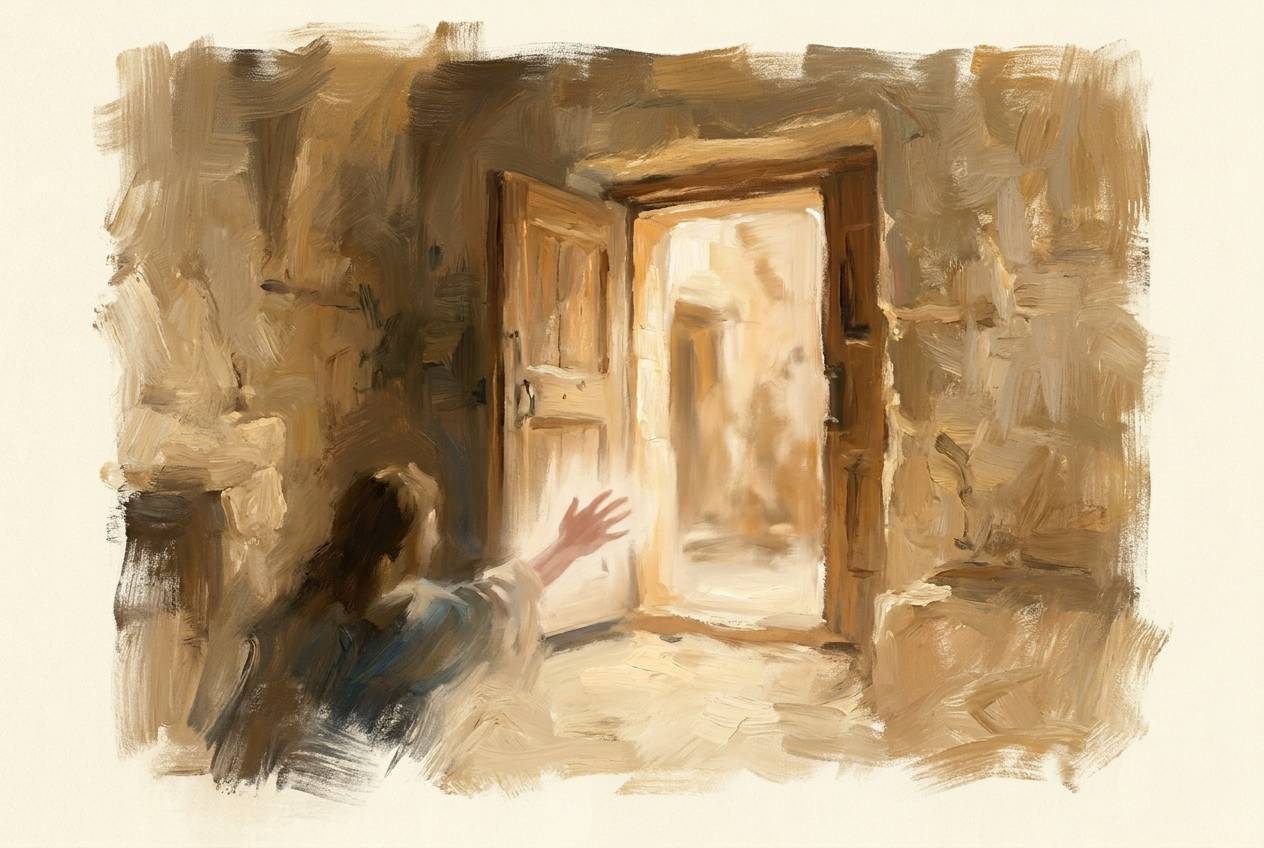
Thomas
He needed evidence. He got an appearance.
The story
Thomas gets one epithet in all of Christian history — Doubting Thomas. It has followed him for two thousand years as a mark of shame, a cautionary tale about weak faith. But read the actual story and something different emerges.
Thomas wasn’t present when Jesus first appeared to the disciples after the resurrection. When the others told him what they had seen, he said: “unless I see the nail marks in his hands and put my finger where the nails were and put my hand into his side, I will not believe.” That’s a very specific, very empirical demand. He wasn’t being obstinate. He was being honest. He needed evidence. He wasn’t going to perform belief he didn’t have.
A week later Jesus appeared again — and this time Thomas was there. Jesus walked straight to him. Offered his hands. Offered his side. “Stop doubting and believe.” Thomas looked at him and said — not tentatively, not partially — “my Lord and my God.” The most complete confession of Christ’s divinity in the entire Gospel of John. From the doubter.
And then Jesus said something that has been misread for centuries: “because you have seen me, you have believed — blessed are those who have not seen and yet have believed.” This is often taught as a rebuke of Thomas. But Jesus didn’t rebuke him. He showed up for him. He offered the evidence Thomas asked for. The words about those who believe without seeing aren’t a shame — they’re an acknowledgment that most people who would come after wouldn’t have the privilege Thomas had. It’s a blessing on future believers, not a critique of Thomas.
What’s more — earlier in John’s Gospel, when Jesus announced He was going back to Judea where people had just tried to stone him, it was Thomas who said to the other disciples: “let us also go, that we may die with him.” This was not a coward. This was a man of deep loyalty who processed the world through what he could verify — and when he could verify it, gave everything.
History gave him a nickname for his doubt. Jesus gave him an appearance.
For you, reading this now
You need evidence. You’re not willing to believe something just because someone told you to, or because it would be comforting, or because everyone around you seems to manage it fine. You need it to make sense. Thomas was the same. When the other disciples told him Jesus had risen he said — show me the wounds, let me touch them, then I’ll believe. He wasn’t performing doubt. He was being honest. And Jesus didn’t shame him for it. He showed up specifically for Thomas, offered exactly the evidence he asked for, and waited. When Thomas saw, he didn’t hedge — he said “my Lord and my God,” the most complete statement of faith in the whole Gospel.
You and I can’t touch those wounds. We don’t get the same proof Thomas got. But Jesus anticipated that too — He looked at Thomas afterward and said: “blessed are those who have not seen and yet have believed.” Not a lesser blessing. A different one. The invitation that was extended to Thomas is still extended to you — not to touch the wounds, but to pursue, to seek, to open the door and see for yourself how good He can be. There’s a reason people throughout history have described encountering God as honey in the rock — something unexpectedly sweet found in the hardest places. You won’t find it by being talked into it. You’ll find it the same way Thomas did — by being honest about where you are, and accepting the invitation to look for yourself.
This character speaks to people who feel…
Read it for yourself
The doubt and the meeting: John 20:24-29 — six verses, devastatingly short.
Where to start: Read those six verses first. Then go back to John 11:1-16 where Thomas earlier said “let us also go, that we may die with him” — the loyalty that history forgot about him.
For going further: John 14:1-7 — the night before the crucifixion, Thomas asks an honest question (“Lord, we don’t know where you are going, so how can we know the way?”) and Jesus gives one of the most famous answers in the Gospels in response.