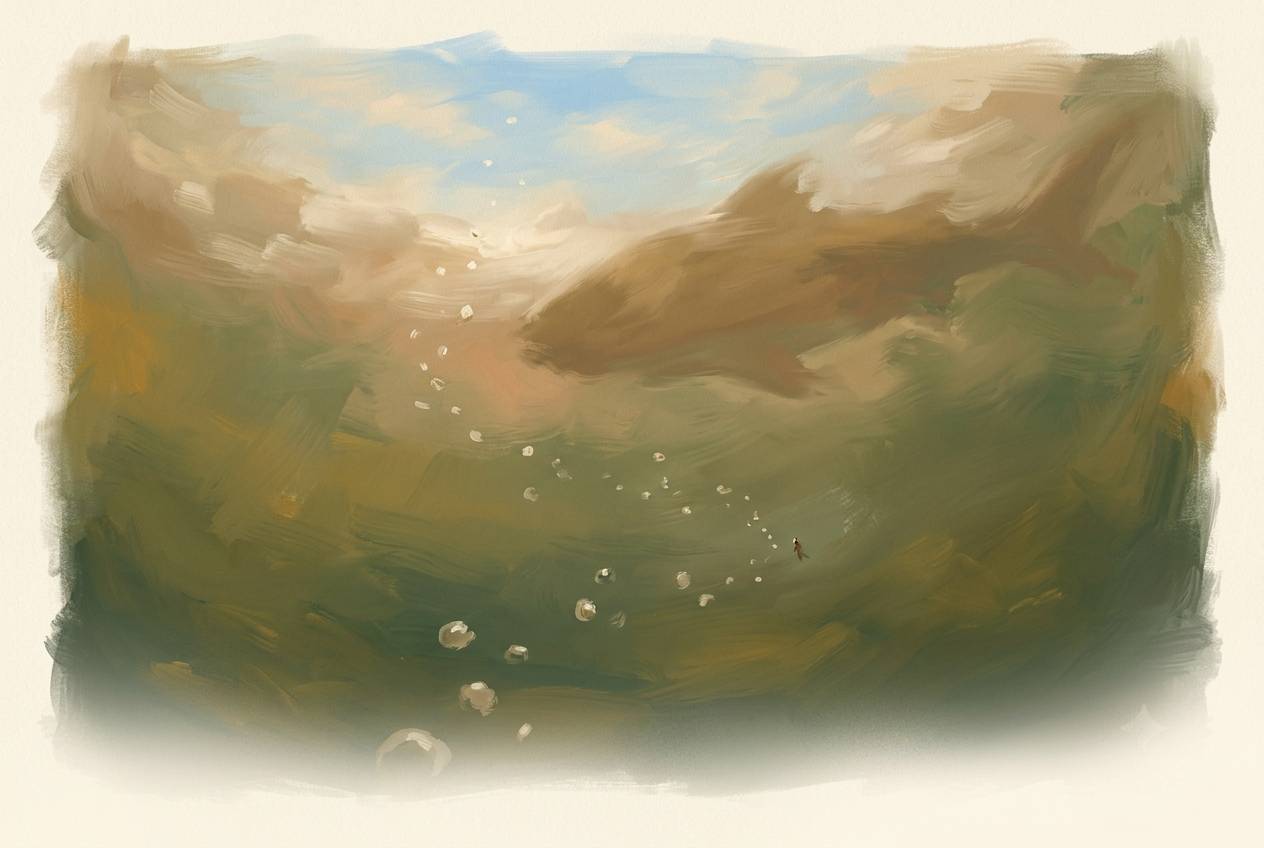
Jonah
The patron saint of people who keep hitting bottom.
The story
Jonah’s story holds three different wounds at once — anger at God, despair, and the disillusionment of having obeyed and still ended up empty.
His rock bottom is one of the most visceral in all of Scripture — literally swallowed by a whale and sitting in its belly in the dark. He had run from God, boarded a ship going the opposite direction, been thrown overboard in a storm, and sunk into the deep. It doesn’t get more rock bottom than that. But the whale wasn’t punishment. It was rescue. Jonah prayed from inside it — “from deep in the realm of the dead I called for help, and you listened to my cry” — and was spit out onto dry land. Given another chance. Sent again.
Jonah’s anger at God is unique in Scripture because it came after obedience, not before. God told him to go to Nineveh — Israel’s great enemy — and warn them of judgment. Jonah eventually went. He preached. And it worked. The entire city repented, from the king down to the livestock. By any measure, the most successful evangelistic mission in the Old Testament.
And Jonah was furious.
He sat outside the city and told God directly: this is why I didn’t want to come. I knew you were a gracious and compassionate God. I knew you’d forgive them. And I didn’t want that. He wanted judgment. He wanted Nineveh to burn. And when God showed mercy instead, Jonah said it would be better for him to die than to live.
God didn’t strike him down for it. He asked him a question: “Is it right for you to be angry?” And then gave him a living object lesson — a plant that gave him shade, then died overnight. Jonah grieved the plant. And God said: you’re upset about a plant you didn’t make and didn’t tend — should I not be concerned about an entire city full of people?
The book ends there. No tidy resolution. Just a question hanging in the air. God’s mercy is wider than our categories for who deserves it. That’s a hard truth — and an honest one. Twice in one story this man hit the floor. Twice God met him there — once with a whale, once with a question — and the story kept going.
For you, reading this now
Maybe your anger at God isn’t about what He didn’t do — it’s about what He did. Maybe He showed mercy to someone who didn’t deserve it in your eyes. Maybe you obeyed, you did the right thing, and the outcome still felt wrong or empty. Jonah went to Nineveh, preached, and watched the whole city repent. And he sat outside and told God he’d rather die than watch those people be forgiven. God didn’t rebuke him harshly. He asked him a question: “Is it right for you to be angry?” And then showed him something about the size of His mercy that Jonah hadn’t been able to see. Your anger is allowed here. But there may be something on the other side of it that you haven’t seen yet either.
If you’re in crisis right now, please reach out to the 988 Suicide and Crisis Lifeline by calling or texting 988. You matter, and help is available.
This character speaks to people who feel…
Read it for yourself
The book: The Book of Jonah — only four chapters. Short enough to read in fifteen minutes.
Where to start: Read the whole book in one sitting. It’s one of the shortest in the Bible and it rewards being taken as a single piece.
A reading note: The book ends with a question from God, unanswered. That’s intentional. Sit with the unresolvedness when you reach it.